- What the code does
- What happens next
- Why trackers show more 7700s than the news
- The emergency codes
- Recent events
What the code does
Every aircraft flying under air traffic control carries a transponder, a small radio that answers radar interrogations with a four-digit code. Controllers assign a unique code to each flight so the radar can tell them apart. Three codes are reserved and never assigned: 7500, 7600 and 7700.
When a crew dials in 7700, the aircraft's data block on every controller's screen is flagged as an emergency. The code is not addressed to one controller; it reaches everyone whose radar can see the aircraft, which is why it is useful when a crew is busy and has not had time to say anything on the radio.
Crews set 7700 for anything they judge to be an emergency: an engine problem, smoke in the cabin, a pressurization fault, a sick passenger, low fuel, a flight control issue. Many crews declare on the radio first ("Mayday" or "Pan-pan") and set the code when the controller asks for it. Others set it immediately. Neither order is required.
What happens next
The controller confirms the emergency, asks for the nature of the problem, the fuel remaining and the number of people on board, and then clears the way. Other traffic is vectored off the arrival path, the emergency flight gets the runway it asks for, and the airport fire service rolls to standby positions along that runway.
From the ground it usually looks like a flight that took off, climbed for a few minutes, turned around and landed again 15 to 40 minutes later.
Fire trucks following the aircraft to the gate is standard procedure, not a sign that something went wrong on landing. A squawk of 7700 does not mean the aircraft is in immediate danger. It means the crew wants priority handling and does not want to argue for it.
Why trackers show more 7700s than the news
The count in the news is lower, because a 7700 that ends with a routine landing rarely becomes a story. The count on some trackers is higher, because a transponder stuck on 7700 while parked at a gate looks the same as a real emergency.
Cockpit filters those out: an event is only shown after the code has been held for a minute, confirmed by a second observation, and seen on an aircraft that is actually moving.
7700, 7600, 7500 and 1200
- 7700General emergency.
Any problem the crew considers serious enough to need priority. The flight usually keeps talking to ATC.
- 7600Radio failure.
The aircraft can fly normally but cannot transmit or receive. It continues on its last clearance and lands using light signals from the tower.
- 7500Unlawful interference.
A hijacking or a threat on board. Controllers follow a separate protocol. Rare, and often set by mistake while dialling 7600 or 7700.
- 1200VFR.
Not an emergency. The default code for aircraft flying visually in the US without a controller assignment.
Recent 7700 events over the US
12 confirmed in the last 30 days, newest first. Private and general aviation aircraft are shown without callsign or registration.
- United 1510 squawks 7700 near Philadelphia
- An aircraft squawking 7700 60 mi from Sarasota/Bradenton, FL
- Military aircraft squawks 7700 near San Antonio, TX
- Military aircraft squawks 7700 emergency near San Antonio
- An aircraft squawking 7700 near Dulles, VA
- A A119 squawking 7700 near Pensacola, FL
- An aircraft squawking 7700 60 mi from Hartford, CT
- An aircraft squawking 7700 50 mi from Orlando, FL
Get the next 7700 as it happens
Cockpit watches every transponder over the US and sends a push when an airliner declares an emergency, with the live position, the recorded track and the tower audio.
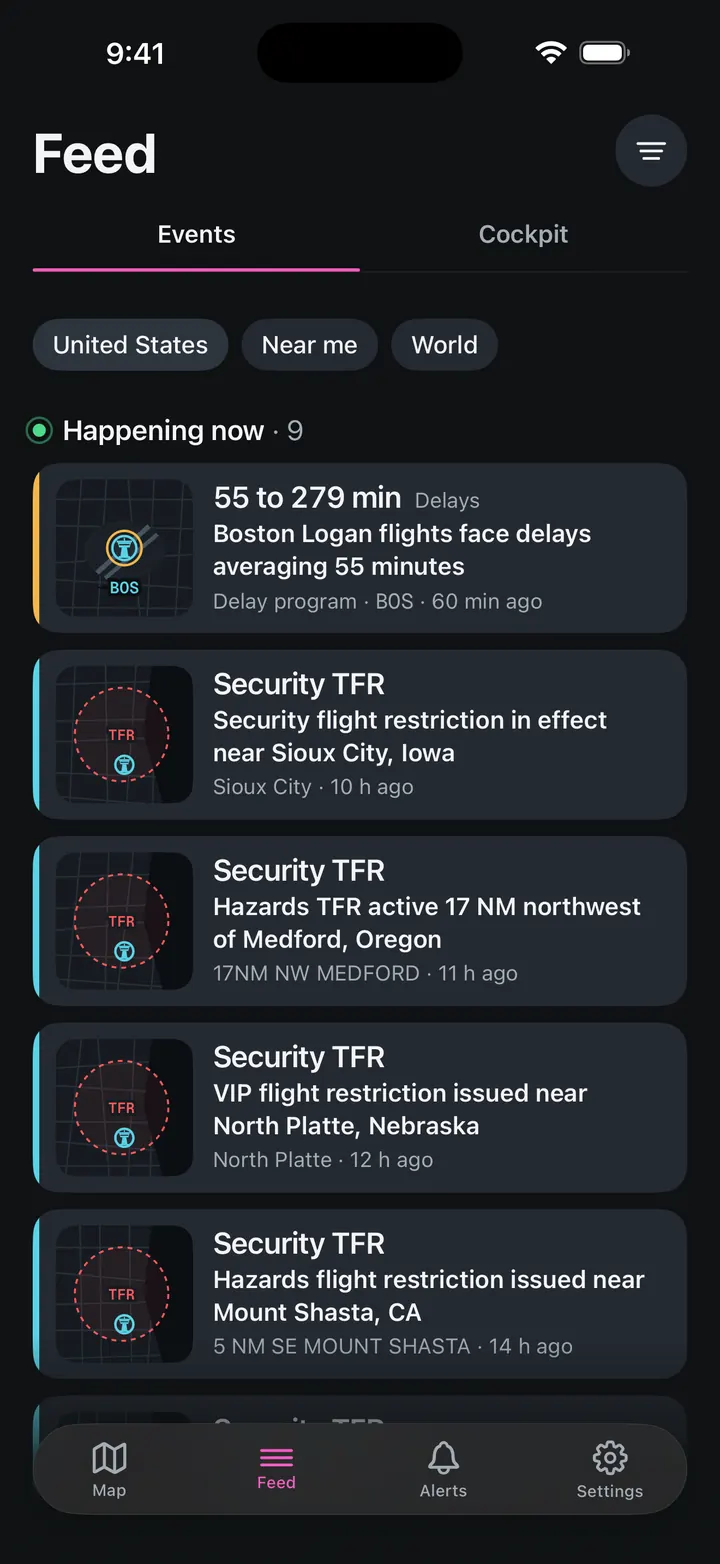
Every emergency in one feed
Open events on top, across the US or near you, with the aircraft and the airport.
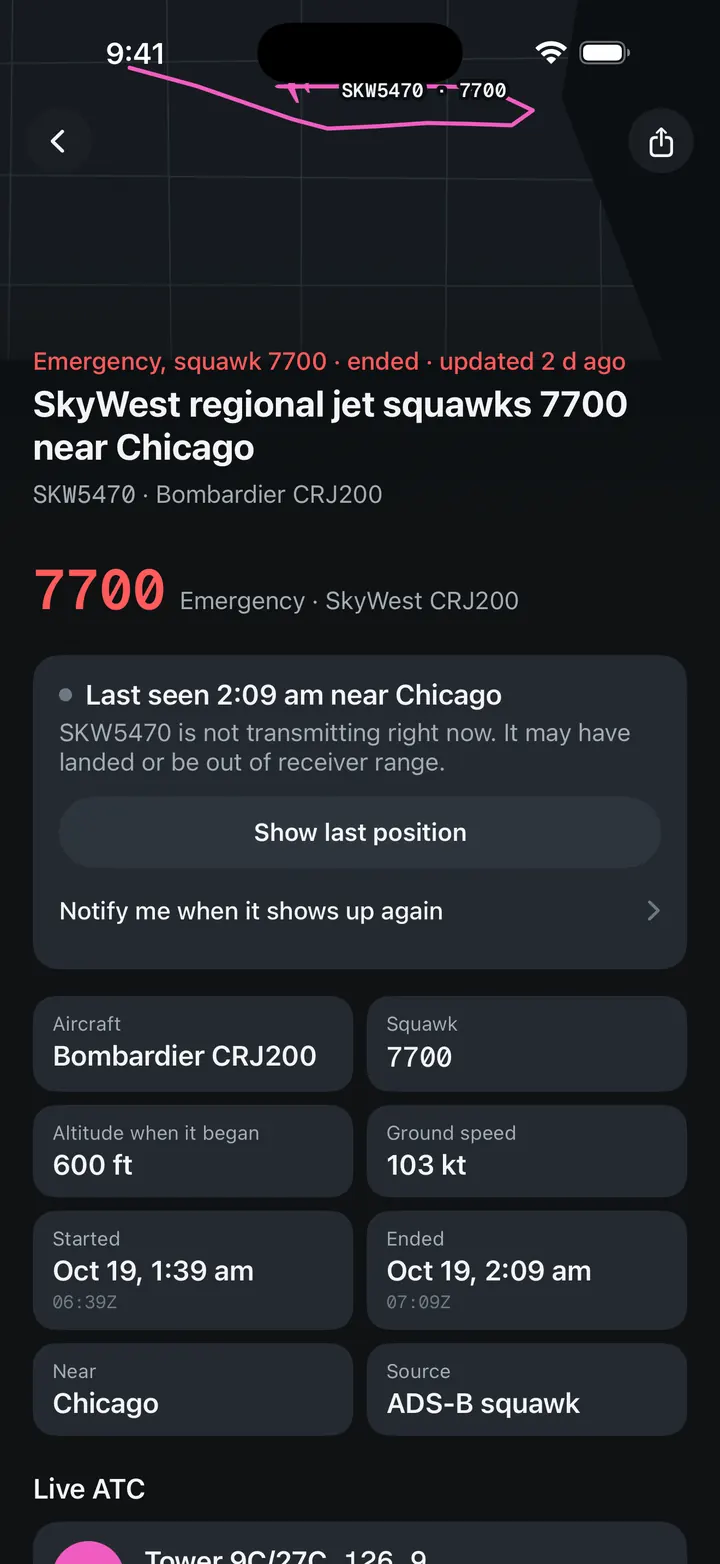
The full story
Last position, altitude when it began, the timeline and a summary, updated while it is open.
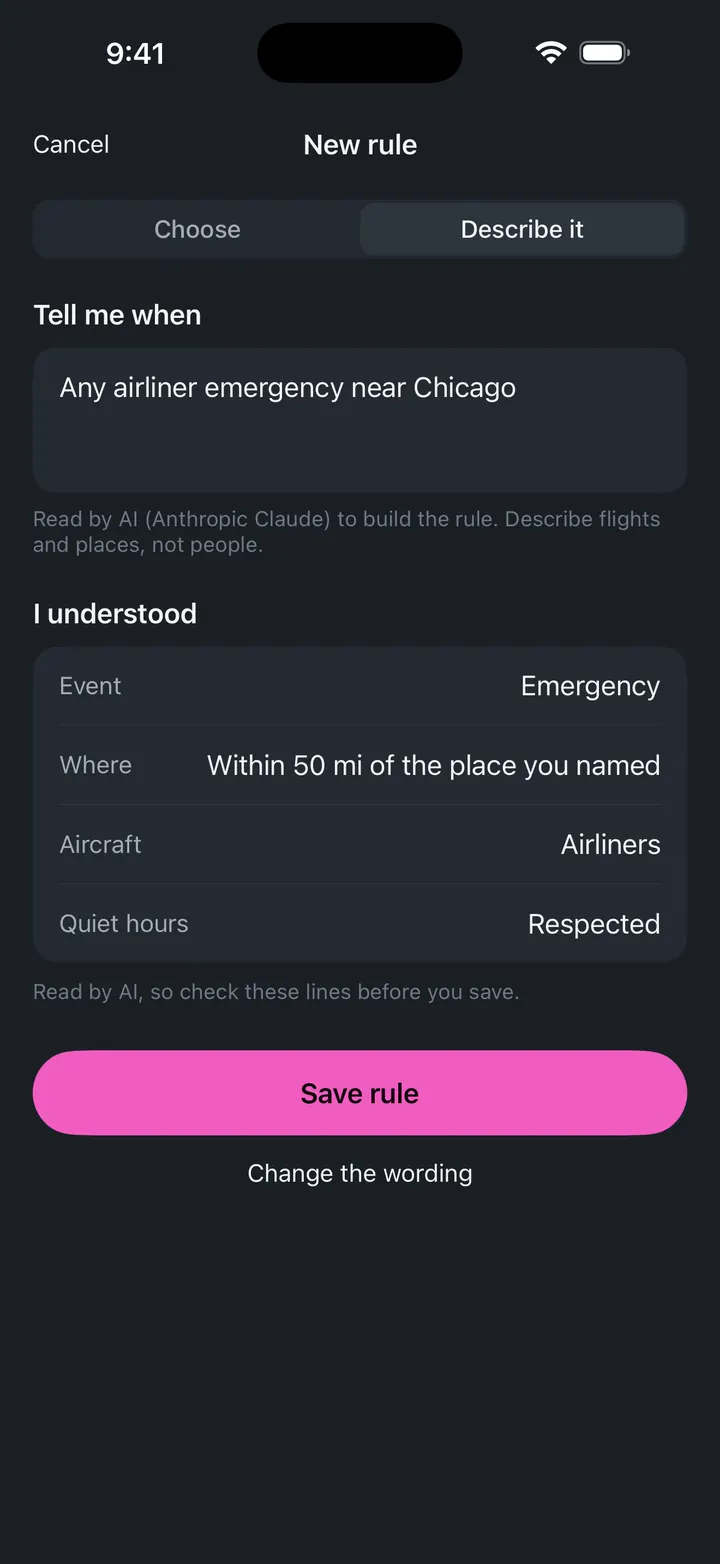
A push when it is near you
Describe the alert in words: "any airliner emergency near Chicago".