What you will hear
Controllers and pilots share one frequency per position, so you hear both sides of every exchange in the order they happen. A busy approach frequency at a hub airport is a stream of short, formulaic transmissions: a controller issues a heading, altitude or speed, the pilot reads it back, the controller moves to the next aircraft. A quiet regional tower at night might go ten minutes between calls.
Each aircraft is identified by its callsign. Airlines use a spoken company name plus the flight number, so Delta 1909 is "Delta nineteen zero nine" and United 2 is "United two". Private aircraft use their registration, "November one two three alpha bravo", often shortened to the last three characters once contact is established.
You will hear altitudes in feet or flight levels (flight level three five zero is 35,000 feet), headings in degrees, speeds in knots and runway numbers read digit by digit: "runway two two left". After an hour it stops sounding like code.
Three ways to listen
1. A handheld scanner or airband radio
The classic way. Any scanner that covers the civil airband, 118 to 137 MHz AM, will do. You hear what is in range of your antenna, which near an airport is everything, and in a city 30 miles away is usually only the high-altitude en-route sectors. The audio is live with no delay and works without a network. The drawback is range: you cannot hear an airport in another state.
2. An app
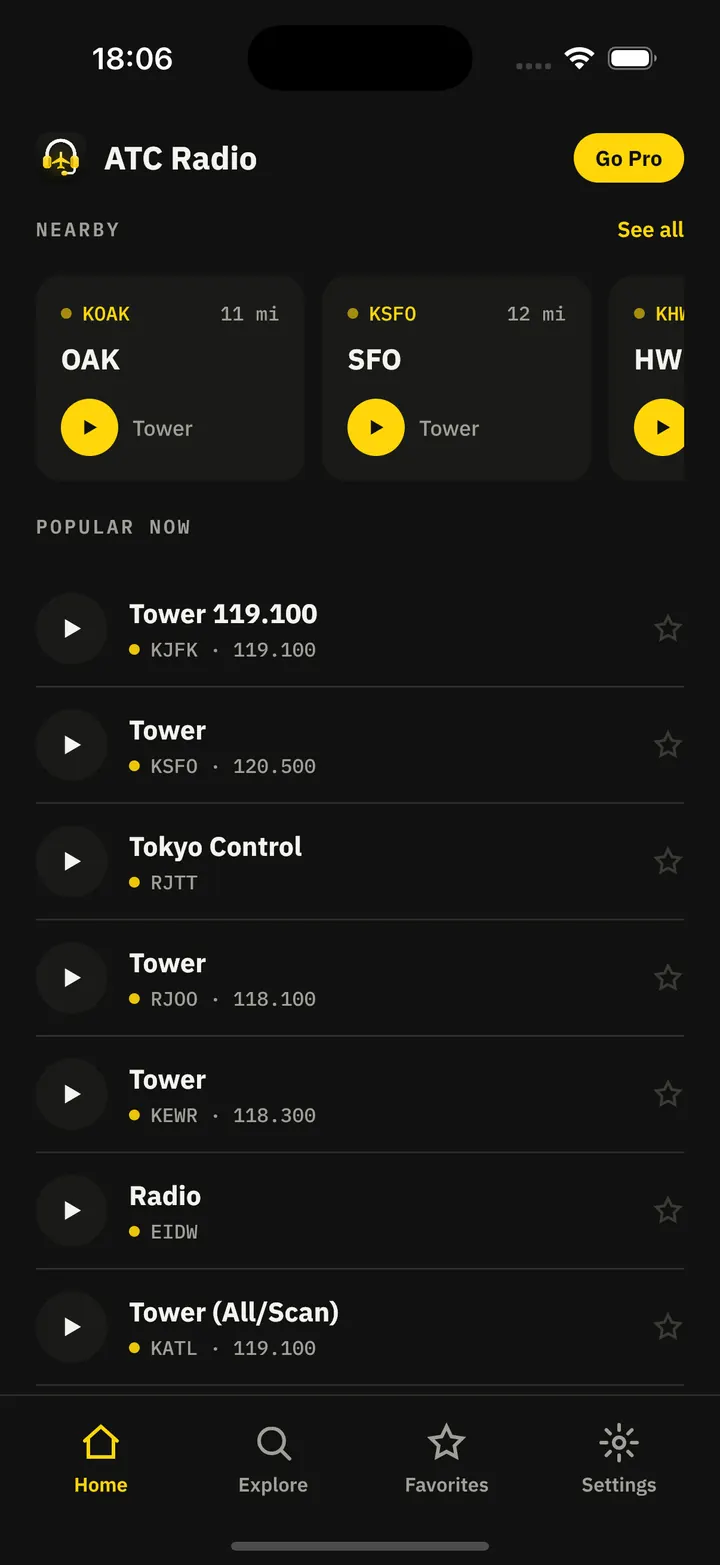
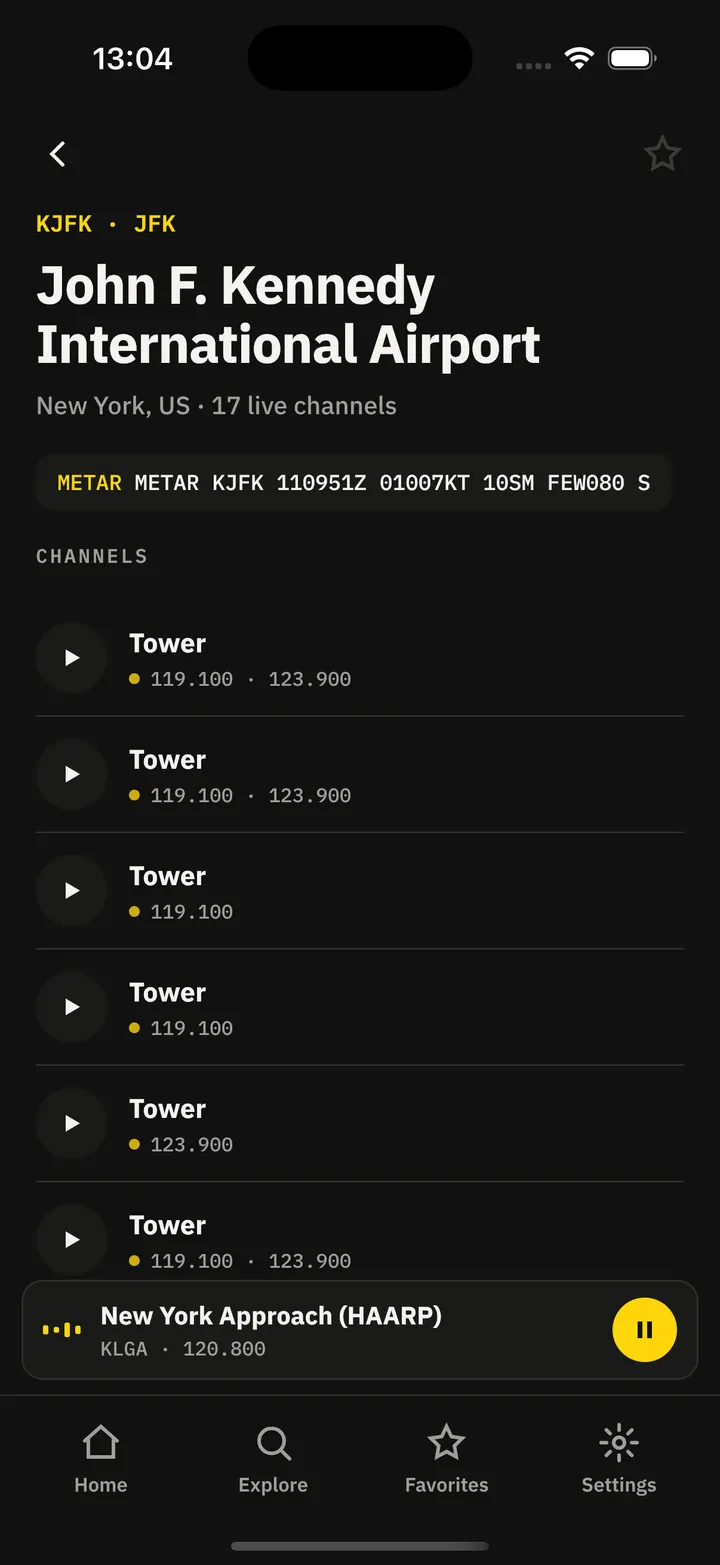
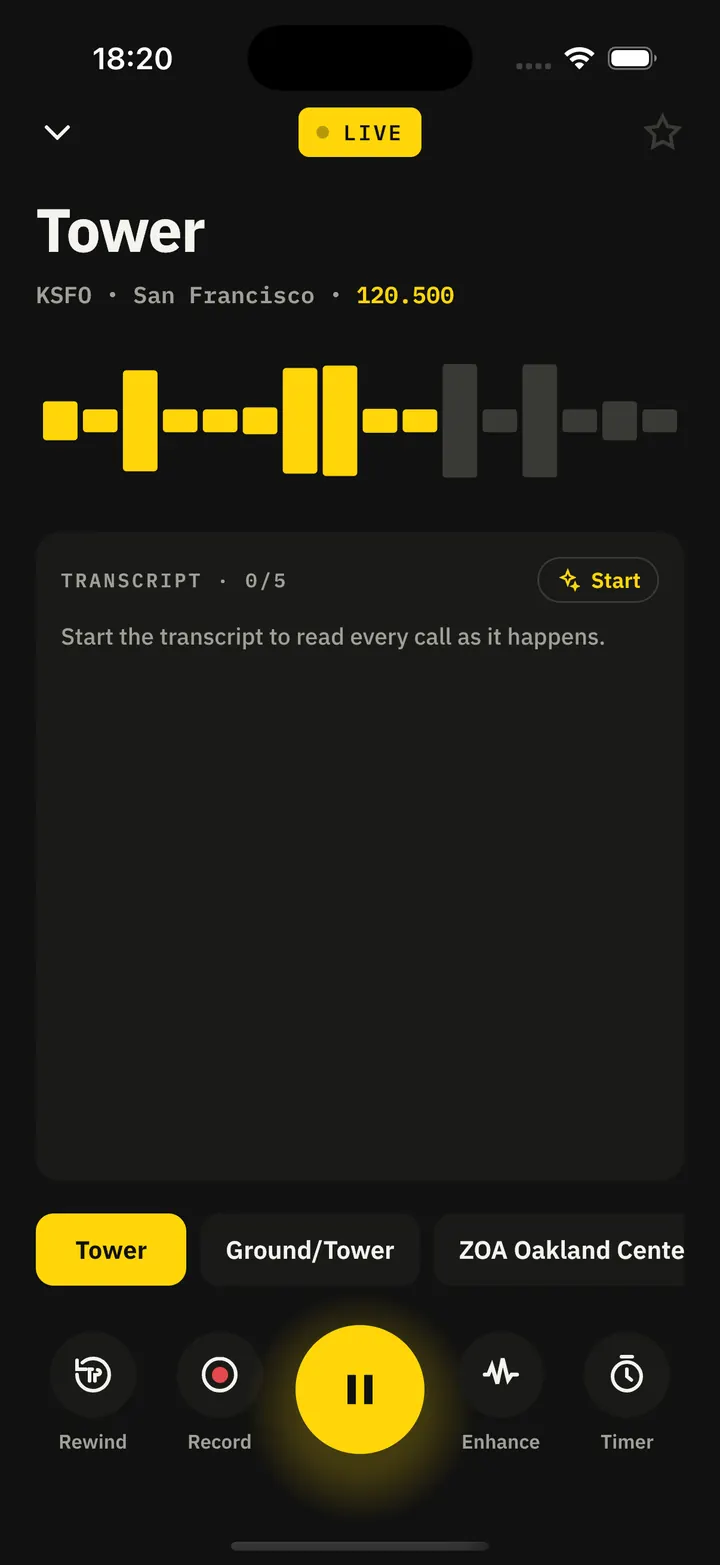
Apps relay feeds from receivers set up near airports to your phone, so you can listen to a tower two thousand miles away. There is a delay of a few seconds to a minute, and coverage depends on where a receiver exists, which in the US means most large airports and many medium ones. Pick an airport, pick tower or approach, press play.
3. A desktop browser
The same relayed feeds can be played on a computer. Useful while working, less useful on a phone, where a browser stream usually stops when the screen locks.
Which frequency to start with
Every controlled airport has several positions, each on its own frequency, and a flight is handed from one to the next as it goes. The diagram at the top of this page shows the order a departure and an arrival pass through.
| Position | What it does | Good for |
|---|---|---|
| Tower | Clears aircraft to take off and land, controls the runways and the airspace a few miles around the field. | Beginners. Short, clear exchanges. |
| Approach | Sequences arrivals from roughly 40 miles out onto the final approach, and climbs departures out of the area. | Hearing how a line of arrivals is built. |
| Ground | Taxi instructions between runway and gate. | Following one flight after landing. |
| Clearance delivery | Reads each departing flight its route before it moves. | Hearing a whole flight plan at once. |
| Center | En-route control between airports, high altitude. | Long, calm stretches. |
Every airport page on this site lists the frequencies for each position, for example JFK, O'Hare and LAX.
Making sense of it
A handful of phrases carry most of the traffic.
- "Cleared for takeoff" and "cleared to land" are the two clearances the tower issues for the runway.
- "Line up and wait" means taxi onto the runway and hold; takeoff clearance comes separately.
- "Descend and maintain" or "climb and maintain" followed by an altitude. The pilot reads the altitude back.
- "Turn left heading two seven zero": a compass heading in degrees, always three digits.
- "Contact approach on one two seven point four" hands the aircraft to the next frequency. Follow it there and you can track a flight from gate to gate.
- "Say again" means repeat. "Unable" means a pilot cannot comply with an instruction.
- "Mayday" is a declared emergency; "pan-pan" is urgency short of an emergency. See squawk 7700 for what happens next.
Numbers are spoken digit by digit, with "niner" for nine in strict usage. Frequencies often drop the leading one in casual speech: "twenty-seven point four" is 127.4.
Is it legal
In the United States, receiving aviation radio is legal, and so is using a scanner or an app at home. Federal law restricts passing on the contents of private communications for profit, which is aimed at intercepted calls, not at air traffic control broadcast in the clear. Some states restrict scanners in vehicles; check before mounting one in your car.
Rules differ by country, and in some countries listening to aviation frequencies without a licence is restricted. Check local law before you listen abroad.
Transmitting on an aviation frequency without a licence is illegal everywhere and carries serious penalties. A scanner cannot transmit. An airband transceiver can; if you own one, the transmit button is not for you.
Listening in ATC Radio
Live tower, ground and approach audio for hundreds of airports, with the busy channels surfaced for you.